ReVanced Sued by Its Own Former Teammates — A Story About "Open Source"
Meet ReVanced — The App That Lets You Watch YouTube for Free
If you use an Android phone, there's a good chance you've heard of — or are even using right now — an app that lets you watch YouTube completely ad-free, play audio in the background without paying for Premium, and enjoy dozens of features that Google normally locks behind a paywall.
That app goes by the name ReVanced.
But to understand ReVanced, we need to go back a step further.
The App That Started It All: YouTube Vanced
Before ReVanced, there was YouTube Vanced — the original "YouTube but without ads." It was a fully modified version of the YouTube app, built by a team of developers who wanted to give users a better experience without forcing them to pay for YouTube Premium. For years, it was beloved by millions of Android users worldwide.
Then in 2022, Google sent Vanced a cease and desist letter, and the project shut down overnight.
The community was devastated — but not for long.
ReVanced Steps In
A new group of developers quickly appeared to fill the void, claiming to "continue the legacy of Vanced." They called their project ReVanced.
ReVanced works slightly differently from its predecessor. Instead of distributing a fully modified YouTube app — which is what got Vanced in legal trouble — ReVanced distributes a patcher: a tool that takes your existing YouTube app and applies modifications on top of it. The result is the same ad-free, feature-rich experience, but in a legal structure that is much harder for Google to attack directly.
The project exploded in popularity, growing into one of the most widely used open-source Android tools in the world, with millions of users across every continent.
The Dark Side of ReVanced's Rise
Open-source or not, every project is only as good as the people running it. And behind the scenes, the ReVanced team had a growing reputation problem.
Community members, contributors, and partner developers began speaking out about an increasingly hostile internal culture. Contributions from external developers were routinely rejected without explanation. The leadership operated in a top-down, opaque manner that left contributors feeling undervalued and unheard. The project's subreddit was eventually shut down indefinitely — a move that cut off a major communication channel between the team and its user base.
Most tellingly: in January 2026, inotia00 — the developer behind the massively popular ReVanced Extended fork — revealed that contributors who had given years to the project were blocked from the ReVanced repository without any explanation. inotia00 was so outraged that they publicly announced the discontinuation of ReVanced Extended as a protest, and explicitly recommended that users switch to an alternative: Morphe.
ReVanced also developed a pattern of using legal tools aggressively to protect its brand — including taking down revanced.net, a community site that helped non-technical users easily install ReVanced and brought the project to a much wider audience, by leveraging trademark and DMCA mechanisms. What made it worse: after forcing the site down, the ReVanced team seized the domain and plastered it with advertisements — a stark contrast to the open, user-first values they publicly claimed to uphold. For a project that loudly champions user freedom and open-source values, the move struck many as deeply hypocritical.
Enter Morphe — Built by Those Who Left
Out of this frustration, a new project was born.
Several developers and contributors who had left ReVanced came together and released Morphe in early 2026 — a fresh start with active maintainers, clear development goals, and an emphasis on community openness.
Functionally, Morphe does essentially the same thing as ReVanced: it patches YouTube and YouTube Music to remove ads, enable background play, restore the dislike counter, and add a suite of power-user features. But its governance is different — transparent and welcoming of contributions.
Because Morphe is a fork of ReVanced's GPLv3-licensed codebase, it is also bound by GPLv3. But Morphe added one extra condition under GPLv3 Section 7 — a simple attribution requirement:
Any application or derivative work that uses Morphe code must display the following user-facing message: "This app uses code from Morphe. To learn more, visit https://morphe.software" — presented as a clickable link.
No money. No permission fees. Just a single line of acknowledgment.
The Conflict — And the Takedown
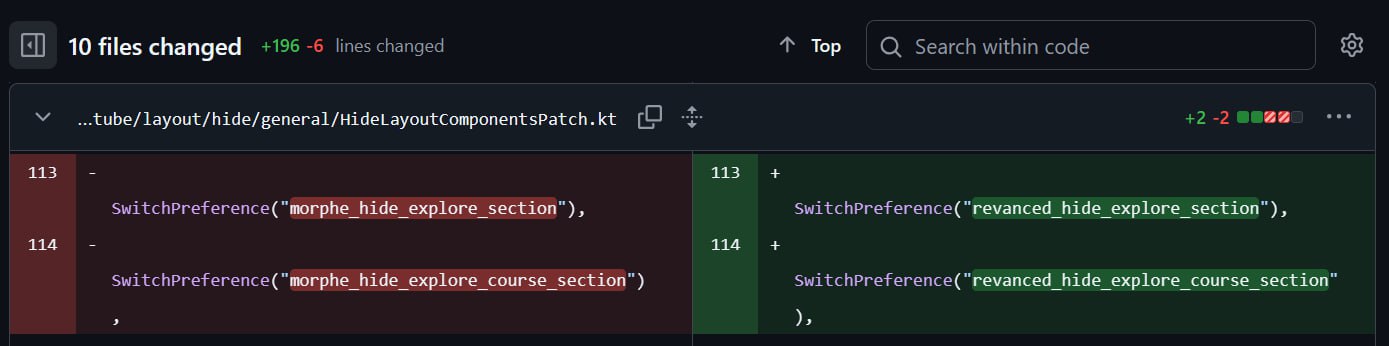
After Morphe launched, the ReVanced team opened an internal development branch for a major update. Members of the Morphe team reviewed the commits and discovered something troubling: a significant portion of the code bore Morphe developers as co-authors — meaning it demonstrably originated from Morphe's own repository — yet there was no attribution anywhere. No mention of Morphe. Nothing.
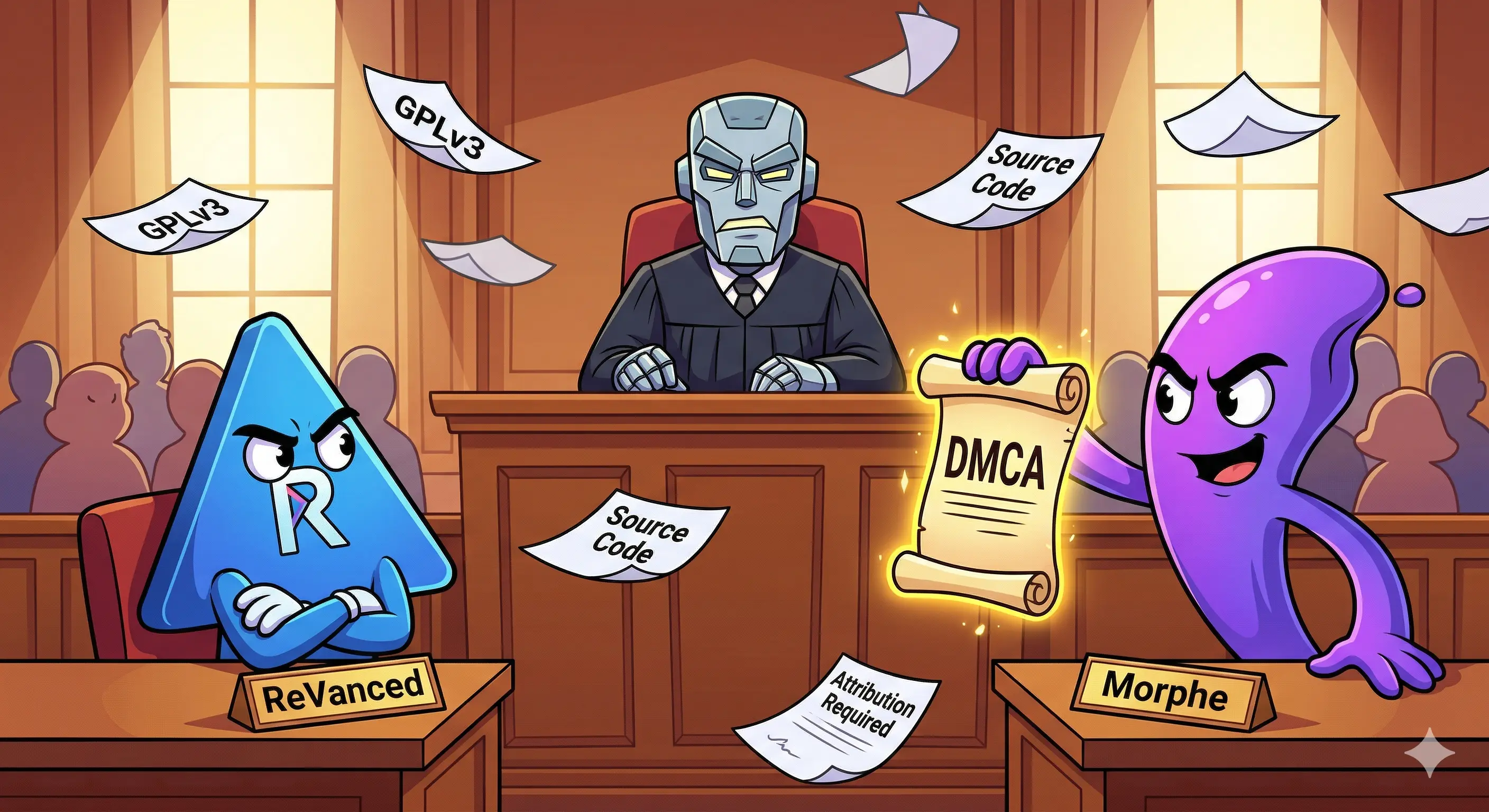
Morphe filed a DMCA takedown notice with GitHub, offering ReVanced two paths to resolution: add the required attribution notice, or have the offending branch permanently deleted.
GitHub processed the request in accordance with its standard procedures. Because the network of affected repositories exceeded 100, the takedown applied to more than 700 repositories in total.
How ReVanced Responded
ReVanced stated in a README left behind in the locked repository that after reviewing the complaint, they had determined it "has no legal basis" and submitted a formal counter-notification to GitHub.
Under the DMCA, once a counter-notification is submitted, the original complainant has 14 days to initiate legal action or accept that the repository will be restored. ReVanced is banking on Morphe not pursuing the matter in court, and development has continued on a GitLab mirror in the meantime.
The Irony That Isn't Lost on Anyone
This is not the first time ReVanced has faced DMCA action. In 2022, the project was hit with takedowns from small app developers accusing ReVanced of bypassing their premium paywalls. In 2025, Spotify filed a DMCA notice targeting the Unlock Premium patch. Each time, ReVanced positioned itself as a scrappy open-source project being bullied by corporate interests.
Now the shoe is on the other foot. The people filing the DMCA are not a corporation. They are former ReVanced contributors — developers who gave years of their time to the project, were blocked without explanation, and then built something new. When that new work was taken from them without credit, they used the same legal mechanism that had been used against ReVanced before.
The requirement Morphe is enforcing isn't about money or market share. It's about a single line of credit. After being erased from a project they helped build, the Morphe developers wanted one thing: acknowledgment.
What Happens Next?
For everyday users, the practical impact is minimal — ReVanced's GitLab mirror is fully operational, and Morphe continues to develop independently.
But for the open-source community at large, this story is a vivid illustration of something that often gets overlooked: open-source licenses have real teeth. The freedom to use, modify, and build on someone else's work comes with obligations. When those obligations are ignored — even by projects that loudly champion the values of open software — the original authors have every right to enforce them.
The Morphe team built something after being pushed out. They asked for one line of credit. They didn't get it.
Now the whole community is watching to see what comes next.
We will continue to follow this story as it develops.
Compiled by the vanced.to team.